Entry Declaration Trends and Market Adjustments Across National Hunt Fixtures
Hugo Carter · Oct 21, 2026

Entry Declaration Trends and Market Adjustments Across National Hunt Fixtures
Entry declarations in National Hunt racing follow structured timelines set by regulatory bodies, and these timelines create observable patterns that influence how betting markets respond during the lead-up to fixtures. Trainers submit declarations at set intervals before each meeting, and the volume plus timing of those submissions often signal changes in field sizes that bookmakers incorporate into their pricing models. Data from recent seasons shows that early declarations tend to stabilize opening odds while late surges can trigger rapid adjustments across multiple runners in the same race.
National Hunt fixtures operate under rules that require declarations several days in advance for most events, yet allowances exist for supplementary entries in certain conditions races. Researchers tracking these submissions note that jump meetings held in autumn months frequently see higher rates of late declarations compared with summer jumps cards, and this timing difference correlates with measurable shifts in market liquidity. In October 2026 several prominent meetings are already listed on the calendar, and analysts expect similar patterns to emerge based on historical submission records from comparable fixtures.
Core Mechanisms Behind Declaration Timing
Declarations arrive through centralized systems managed by bodies such as the British Horseracing Authority, and each submission updates the official field list that feeds directly into bookmaker systems. When multiple trainers declare strong contenders at the same time, market layers often tighten around those runners while drifting others that remain unconfirmed. Observers monitoring these flows have documented how a cluster of declarations from a single stable can compress odds on that yard’s runners while simultaneously pushing out prices on rivals perceived as less likely to participate.
Supplementary entry stages add another layer, allowing trainers to add horses after the main declaration deadline in exchange for higher fees. These additions frequently occur when ground conditions change or when a stable’s primary runner suffers an issue, and the resulting market reaction tends to be sharper because fewer participants have time to adjust positions. Figures compiled over multiple seasons indicate that races receiving supplementary declarations show average price movements roughly twice as large as those with static fields.
Observed Effects on Betting Market Behavior
Market shifts become most pronounced in handicap chases and novice hurdles where field sizes vary widely. Early declarations allow layers to build books with greater certainty, whereas a rush of late declarations forces repeated recalculations that can produce volatility lasting several hours. Studies conducted by industry research groups have tracked these movements across Irish and British tracks, revealing that certain venues experience more pronounced swings because their typical field sizes sit near the threshold where additional runners meaningfully alter win probabilities.
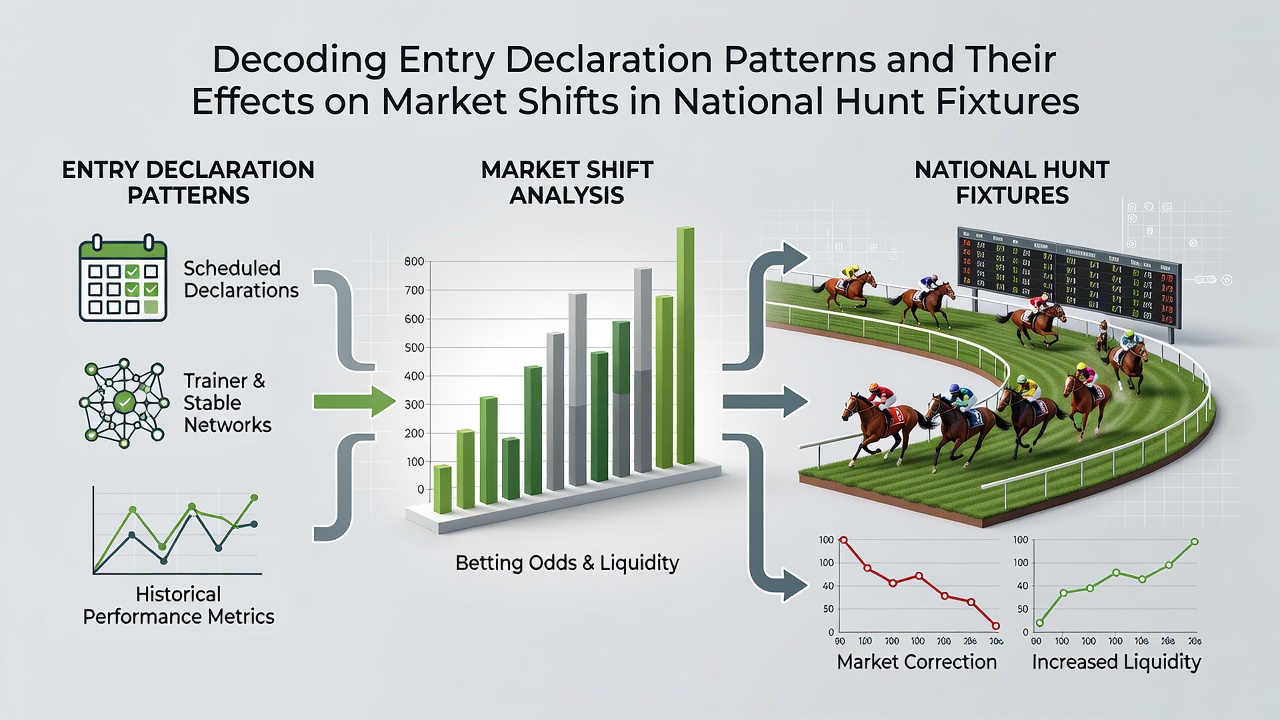
One dataset covering fixtures from 2023 through 2025 demonstrated that races with declaration counts finalized more than forty-eight hours ahead exhibited steadier morning odds lines than those finalized closer to race day. The same dataset highlighted regional differences, with northern tracks showing slightly higher volatility linked to weather-related declaration changes. Trainers operating across multiple yards sometimes coordinate declarations to manage stable resources, and these coordinated moves create secondary effects when bookmakers detect patterns across several races on the same card.
Regional Variations and Regulatory Context
Rules governing declarations differ between Britain and Ireland, and these differences influence how markets incorporate information. Horse Racing Ireland publishes detailed submission statistics that allow participants to compare current trends against historical averages for equivalent meetings. In contrast, Australian racing authorities maintain separate protocols for jump events that rarely overlap with National Hunt schedules, yet cross-jurisdictional trainers occasionally reference those systems when planning international campaigns. European regulatory frameworks also shape declaration windows, and trainers competing across borders must navigate multiple sets of deadlines that can create staggered information flows into betting markets.
Weather reports released during the declaration window add another variable because trainers often delay submissions until ground conditions clarify. When forecasts shift suddenly, the resulting cluster of declarations or withdrawals produces concentrated market activity that layers must absorb quickly. Records from past October meetings show that such weather-driven adjustments have altered starting prices by more than ten percent in several well-documented cases.
Conclusion
Declaration patterns in National Hunt racing supply structured data points that betting markets process continuously from the initial entry stage through to race time. The timing, volume, and origin of submissions create measurable influences on odds movements, and these influences vary by fixture type, region, and external factors such as weather. Continued monitoring of submission records alongside market data provides ongoing insight into how information flows translate into price adjustments across the jump racing calendar.